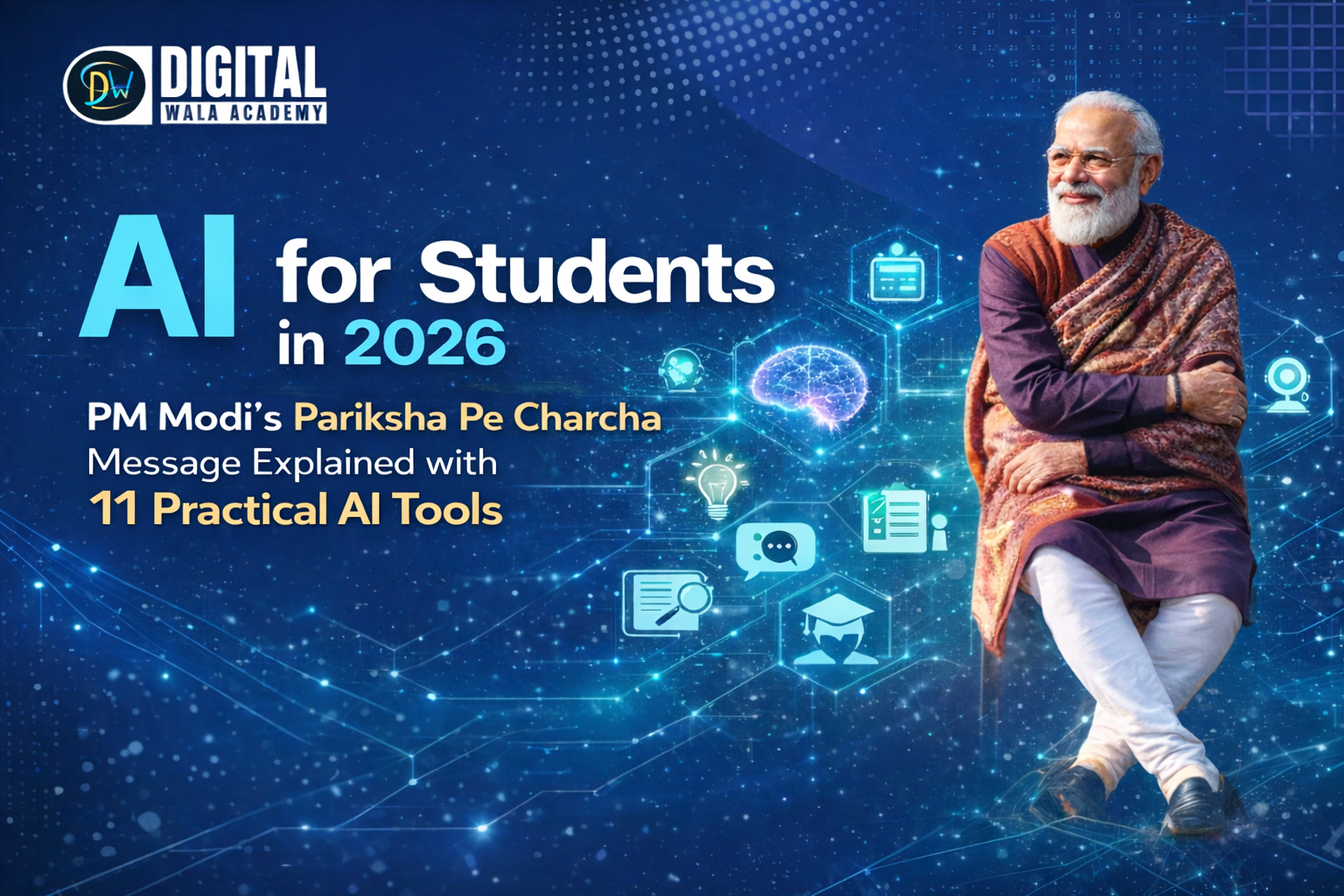
AI for Students in 2026: PM Modi’s Pariksha Pe Charcha Message Explained with 10 Practical AI Tools The Prime Minister of India engages with students annually through “Pariksha Pe Charcha,” an interactive platform designed to address exam-related stress and foster holistic development. This initiative was started in 2018. Pariksha Pe Charcha 2026 was held on 6 February 2026. In this year’s interaction, the relevance of AI was highlighted as a supportive tool in education, aligning with modern learning needs. PM Modi’s Words on AI at Pariksha Pe Charcha 2026 During Pariksha Pe Charcha 2026, PM Modi addressed the role of Artificial Intelligence in students’ lives with these exact words: “Artificial intelligence may increase our capabilities, but we should not get dependent on it.” He further stated, “It must be deployed as a tool to enhance strength and wisdom, not just entertainment. Our generation lacked such opportunities. Today’s youngsters must use artificial intelligence wisely.” Additionally, he remarked, “This way, you are using AI for your benefit, not becoming dependent on it.” These statements underscore a balanced approach to technology. What This Means for Students PM Modi’s message on AI encourages students to view it as a helpful companion rather than a complete substitute for personal effort. In simple terms, AI can assist in organizing thoughts, clarifying doubts, and providing quick insights, allowing students to focus on deeper understanding and critical thinking. For instance, it can summarize complex topics or suggest study resources, but it should not replace the discipline of reading, practicing, or reflecting independently. This approach helps build focus and resilience, ensuring AI supports learning without diminishing the value of hard work and original ideas. Top 10 AI Tools Recommended by DigitalWala AI Academy for Students These tools are recommended by DigitalWala AI Academy to align with responsible AI usage, as emphasized in PM Modi’s message. They cover focus, homework, writing, and productivity, promoting ethical application in education. 1. Brain.fm Brain.fm uses AI to generate personalized soundscapes that enhance concentration and mental clarity. Students should use it responsibly by setting focused study sessions with its audio tracks to minimize distractions and maintain a calm mind during revision. They should not depend on it for motivation, as true discipline comes from consistent habits rather than external aids. 2. Focus@Will This tool employs AI-driven music playlists tailored to individual productivity patterns, helping with focus and a clean mindset. Use it responsibly to create a conducive environment for studying, adjusting tracks based on task type for optimal attention. Do not rely on it to avoid building internal focus skills, such as time management without audio cues. 3. ChatGPT ChatGPT assists with homework by explaining concepts, generating practice questions, and clarifying doubts across subjects. Students should use it responsibly to brainstorm ideas or break down topics, always verifying information with textbooks or teachers. Avoid depending on it for complete answers, as this can hinder critical thinking and original problem-solving. 4. Socratic by Google Socratic leverages AI to provide step-by-step explanations for homework problems and concept clarity in math, science, and more. Use it responsibly by inputting questions to understand processes, then applying the knowledge independently in assignments. Do not depend on it for direct solutions, ensuring personal effort in learning to foster deeper comprehension. 5. Grammarly Grammarly offers AI-powered writing assistance, checking grammar, style, and clarity in essays and reports. Students should use it responsibly to refine drafts, learning from suggestions to improve their writing over time. Avoid relying on it for content creation, as it cannot replace original ideas or research integrity. 6. QuillBot QuillBot uses AI for paraphrasing, summarizing, and enhancing research-based writing. Use it responsibly to rephrase sentences for better flow while citing sources, aiding in clear expression of personal insights. Do not depend on it to rewrite entire papers, as this undermines authentic voice and academic honesty. 7. Perplexity AI This research tool employs AI to gather and summarize information from reliable sources, supporting writing and study. Students should use it responsibly to explore topics quickly, cross-checking facts for accuracy in projects. Avoid depending on it as the sole source, always consulting primary materials to develop research skills. 8. Notion AI Notion AI integrates into a productivity platform for study planning, note organization, and task management. Use it responsibly to create schedules, summarize notes, and track progress, adapting plans based on personal needs. Do not rely on it for decision-making, as effective planning requires self-reflection and adjustment. 9. Quizlet AI Quizlet AI generates flashcards and quizzes for productivity and concept reinforcement in study routines. Students should use it responsibly to customize study sets for active recall, reviewing material regularly. Avoid depending on it for memorization without understanding, ensuring engagement with core concepts. 10. Otter.ai Otter.ai transcribes lectures and meetings with AI, aiding productivity by organizing audio into searchable notes. Use it responsibly to review class discussions, highlighting key points for better study planning. Do not depend on it to skip active listening, as participation in real-time builds essential comprehension. 11. Forest AI Forest AI helps students build focus and mental discipline by encouraging distraction-free study sessions. It uses AI-driven focus timers and progress tracking to promote deep work and a calm study mindset. Use it responsibly to reduce screen distractions, improve concentration, and maintain a clean, focused mind during study hours. Do not depend on it as a substitute for self-discipline—true focus develops through consistent effort and conscious habit-building. In the evolving landscape of education, research suggests that AI integration can enhance learning efficiency, though its impact varies by individual application. It seems likely that balanced use promotes better outcomes, with evidence leaning toward tools that support rather than supplant human effort. While AI offers promising aids, the evidence leans toward its role as a facilitator, especially amid debates on over-reliance in academic settings. Key Benefits of AI Tools for Students Accessibility: Many are free or low-cost, democratizing education. Efficiency: Saves time on routine tasks, allowing focus on creativity. Personalization: Adapts to user needs, improving engagement. However, potential drawbacks