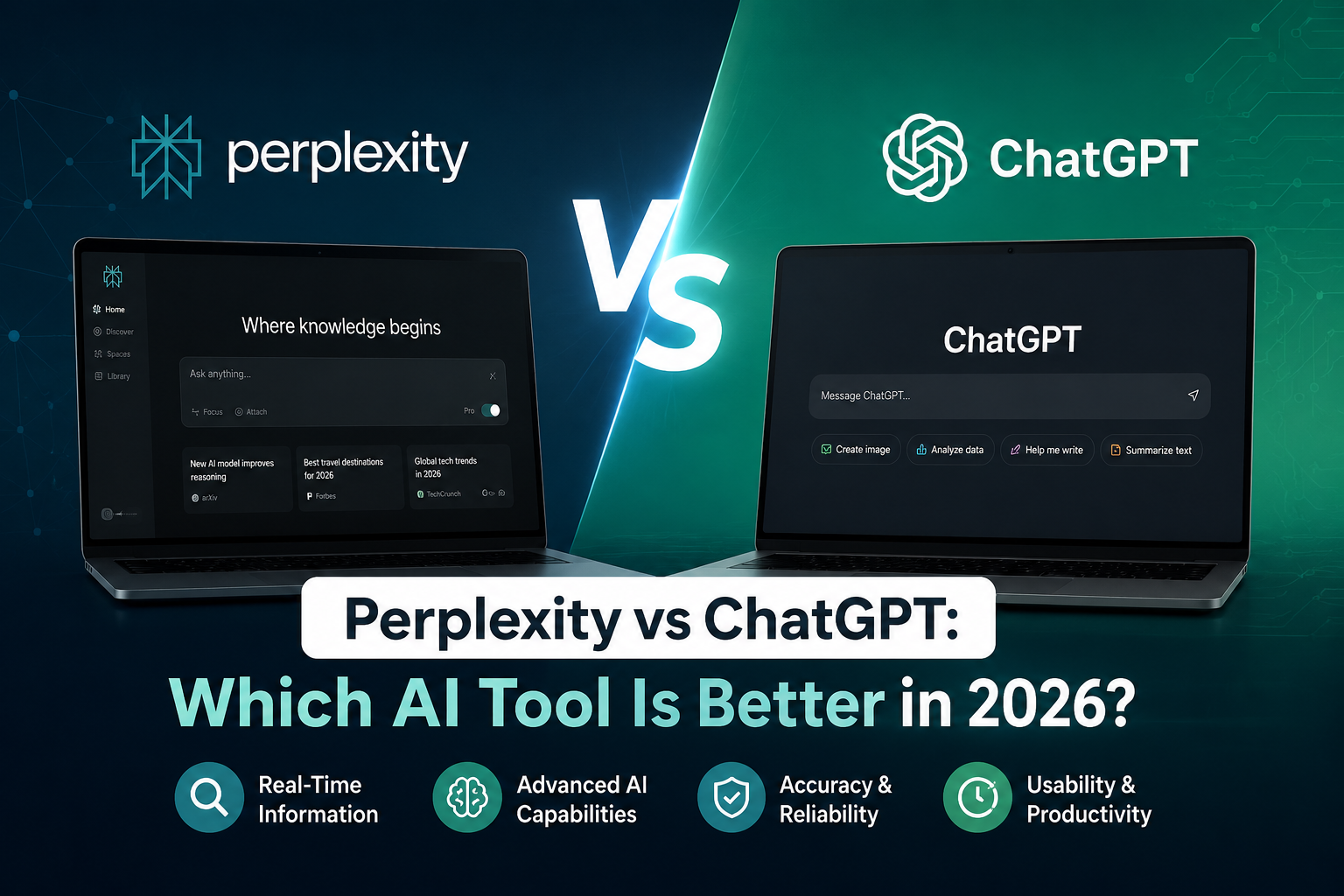
Perplexity vs ChatGPT: Which AI Tool Is Better in 2026? Perplexity vs ChatGPT: Which AI Tool Is Better in 2026? This is one of the most frequently asked questions among students, digital marketers, business owners, and professionals who want to choose the right AI assistant. In this guide, we’ll compare both tools in detail to help you decide which one is the better choice for your work. If you’re wondering “Perplexity vs ChatGPT: Which AI tool is better?”, you’re not alone. Thousands of users search for this comparison every month to decide which AI assistant best suits their needs. In this comprehensive guide, we’ll compare ChatGPT and Perplexity across content writing, research, SEO, coding, accuracy, pricing, speed, user experience, and digital marketing. By the end of this article, you’ll clearly understand which AI tool is the better choice for your work in 2026. Why AI Tools Matter More Than Ever in 2026 Artificial Intelligence is no longer just a trend—it has become a necessity. Businesses are using AI to automate repetitive tasks, create better marketing campaigns, improve customer service, and make data-driven decisions. Likewise, students rely on AI for learning, while professionals use it to increase productivity and save valuable time. Furthermore, AI tools can summarize lengthy documents, generate high-quality content, assist with coding, and even provide strategic business recommendations. As a result, choosing the right AI assistant can significantly improve both personal and professional efficiency. Some of the biggest benefits of AI tools include: Faster content creation Better online research Improved SEO optimization Coding assistance Marketing automation Business productivity Data analysis Time savings Therefore, selecting the right AI platform is one of the smartest decisions professionals can make in 2026. Quick Comparison: Perplexity vs ChatGPT Feature ChatGPT Perplexity AI Content Writing ⭐⭐⭐⭐⭐ ⭐⭐⭐⭐☆ SEO Assistance ⭐⭐⭐⭐⭐ ⭐⭐⭐⭐☆ Research ⭐⭐⭐⭐☆ ⭐⭐⭐⭐⭐ Coding ⭐⭐⭐⭐⭐ ⭐⭐⭐☆☆ Real-Time Information ⭐⭐⭐⭐☆ ⭐⭐⭐⭐⭐ Creativity ⭐⭐⭐⭐⭐ ⭐⭐⭐☆☆ Accuracy ⭐⭐⭐⭐☆ ⭐⭐⭐⭐⭐ Source Citations Limited Excellent Business Use ⭐⭐⭐⭐⭐ ⭐⭐⭐⭐☆ Free Version Yes Yes Quick Verdict: If your primary goal is content creation, SEO, coding, or digital marketing, ChatGPT is generally the stronger choice. However, if your priority is accurate research with cited sources, Perplexity AI stands out. What is ChatGPT? ChatGPT is an advanced AI chatbot developed by OpenAI. It is widely used by marketers, writers, developers, educators, entrepreneurs, and businesses to generate content, solve technical problems, brainstorm ideas, and automate workflows. One of ChatGPT’s biggest strengths is its ability to produce natural, engaging, and context-aware responses. Whether you’re writing a blog, planning a marketing campaign, creating social media content, or learning a new programming language, ChatGPT can significantly improve your productivity. Key Features of ChatGPT Long-form blog writing SEO-optimized content generation Email writing Social media content Coding support Marketing strategy Business planning AI-powered brainstorming Prompt engineering Workflow automation Pros of ChatGPT Excellent for long-form content Outstanding creativity Strong coding capabilities Great for SEO and marketing User-friendly interface Supports multiple industries Cons of ChatGPT Advanced features require a paid subscription Some responses should be fact-checked Source citations are not always included automatically What is Perplexity AI? Perplexity AI is an AI-powered answer engine designed to deliver accurate, up-to-date information with source citations. Unlike traditional AI chatbots, Perplexity combines conversational AI with real-time web search, making it especially useful for research and fact-checking. Instead of simply generating responses, Perplexity provides references from trusted websites, allowing users to verify the information easily. This makes it an excellent choice for students, researchers, journalists, consultants, and professionals who need reliable answers. Key Features of Perplexity AI Real-time web search Source-backed answers Research summaries Citation support Academic assistance Follow-up questions Fast information retrieval AI-powered search engine Pros of Perplexity AI Highly accurate research Real-time information Trusted source citations Excellent for fact-checking Ideal for academic work Cons of Perplexity AI Less creative than ChatGPT Limited for persuasive marketing copy Not the best option for long-form storytelling Perplexity vs ChatGPT: Which One Should You Choose? The answer depends on your goals. If your work involves content writing, SEO, digital marketing, copywriting, coding, and business strategy, ChatGPT offers greater flexibility and creativity. On the other hand, if you spend most of your time conducting research, verifying facts, reading academic sources, or analyzing recent information, Perplexity AI is often the better option because of its citation-based approach. Many professionals actually use both tools together. For example, they use Perplexity AI to collect accurate information and then use ChatGPT to transform that information into engaging blogs, reports, presentations, or marketing content. This combination helps maintain both accuracy and readability. Perplexity vs ChatGPT: Detailed Feature Comparison Choosing between ChatGPT and Perplexity AI depends on your goals. While both platforms use advanced AI models, they are built for different purposes. Let’s compare them feature by feature. 1. Content Writing If you’re a blogger, copywriter, digital marketer, or business owner, content quality matters the most. ChatGPT ChatGPT is one of the best AI tools for content creation. It can generate blog posts, website copy, product descriptions, email campaigns, ad copies, landing pages, and social media captions in a natural, human-like tone. Additionally, ChatGPT understands brand voice and can rewrite content in different styles, making it an excellent choice for businesses and marketing agencies. Perplexity AI Perplexity AI can also generate content. However, its primary strength is summarizing information rather than creating engaging marketing content. Most responses are informative but may require editing before publishing. For content writing, storytelling, blogging, and copywriting, ChatGPT clearly outperforms Perplexity. Perplexity vs ChatGPT for SEO SEO professionals need AI tools that can generate optimized content, keyword ideas, meta descriptions, FAQs, and content briefs. ChatGPT ChatGPT helps marketers: Generate SEO-friendly blog posts Create title tags Write meta descriptions Optimize headings Generate schema ideas Create internal linking strategies Produce FAQ content Improve readability It also assists in topical authority planning and content clustering. Perplexity AI Perplexity is excellent for SEO research. For example, it can: Find recent ranking articles Analyze competitors Discover trending topics Collect statistics Find authoritative sources However, it is not as strong as
Tag: AI technology
ChatGPT: Transforming Conversations with AI – A Comprehensive Guide
Introduction In an era where technology is reshaping how we live, work, and connect, ChatGPT has emerged as one of the most transformative AI tools to date. Developed by OpenAI, ChatGPT leverages advanced natural language processing to create human-like conversations that span a wide range of topics—from casual chats to complex technical assistance. What makes ChatGPT stand out isn’t just its ability to mimic human dialogue but its versatility and potential to enhance productivity across industries. In this blog, we’ll unpack what ChatGPT is, how it works, its real-world applications, its benefits and challenges, and where it’s headed in the future. What Exactly is ChatGPT? At its core, ChatGPT is a sophisticated AI chatbot built on OpenAI’s GPT architecture—currently refined to GPT-4 and GPT-4o versions. Unlike traditional rule-based chatbots that rely on pre-defined scripts, ChatGPT uses machine learning and deep learning to generate contextually relevant and dynamic responses. Trained on massive datasets, including books, articles, and online conversations, ChatGPT can understand context, nuance, and even humor. This makes it capable of engaging in everything from casual conversation to in-depth discussions on science, technology, business, or even creative storytelling. How Does ChatGPT Work? ChatGPT’s magic lies in its transformer-based architecture—a neural network design that processes text by understanding the relationships between words in a sequence. Here’s a simple breakdown: Tokenization: When you type a question or prompt, ChatGPT breaks it down into smaller units called tokens. Context Understanding: The AI analyzes these tokens and considers previous exchanges (in a conversation) to maintain context. Response Generation: Using its training and understanding of language patterns, the model generates a coherent response tailored to the prompt. This dynamic process allows ChatGPT to handle complex queries, maintain conversational flow, and even simulate empathy or humor. Real-World Applications of ChatGPT ChatGPT’s capabilities extend far beyond simple question-answering. Let’s explore some of the most impactful applications across different sectors: ✅ Customer ServiceBusinesses are increasingly turning to ChatGPT to handle customer inquiries, support tickets, and FAQs. Its 24/7 availability ensures customers receive instant assistance, improving satisfaction and reducing the burden on human agents. ✅ Education and TutoringChatGPT is a powerful educational companion. Students use it to get explanations on challenging topics, practice language skills, or brainstorm project ideas. Educators leverage it to generate lesson plans, quizzes, and learning materials. ✅ Content CreationWriters, bloggers, and marketers use ChatGPT to brainstorm ideas, draft articles, and refine content. Its ability to generate human-like text makes it an indispensable tool for speeding up the creative process. ✅ Healthcare SupportWhile not a substitute for medical professionals, ChatGPT can help patients understand symptoms, provide general health advice, and direct them to appropriate resources. This is especially valuable in areas with limited healthcare access. ✅ Software DevelopmentDevelopers use ChatGPT as a coding assistant, debugging tool, and learning aid. It can explain code, suggest improvements, and even help write new functions. ✅ Personal ProductivityFrom drafting emails to summarizing reports, ChatGPT helps professionals save time and stay organized. Its ability to handle repetitive tasks allows humans to focus on higher-value work. Benefits of ChatGPT The rapid adoption of ChatGPT is fueled by its many advantages: 🌟 Efficiency and SpeedChatGPT can handle multiple conversations simultaneously, making it an efficient solution for businesses looking to scale their support and engagement. 🌟 Consistency and ReliabilityUnlike humans, ChatGPT doesn’t get tired or distracted, ensuring consistent and accurate responses at all times. 🌟 Cost-EffectiveImplementing ChatGPT can reduce operational costs by automating routine tasks and freeing up human employees for more strategic roles. 🌟 PersonalizationChatGPT can be fine-tuned or integrated with user data to provide personalized experiences, making interactions more engaging and relevant. 🌟 Continuous LearningWhile the core model is static after training, it can be updated and fine-tuned periodically to incorporate new knowledge and improve performance. Challenges and Limitations Despite its impressive capabilities, ChatGPT isn’t without its limitations. Understanding these challenges is essential for responsible use: ⚠️ Accuracy ConcernsChatGPT can sometimes generate plausible-sounding but incorrect or misleading information, especially when dealing with ambiguous prompts. Users should always verify critical information from reliable sources. ⚠️ Lack of True UnderstandingWhile ChatGPT is excellent at simulating conversation, it doesn’t truly understand the world like humans do. It generates responses based on patterns rather than genuine comprehension. ⚠️ Bias in ResponsesBecause ChatGPT learns from large datasets that include human biases, it can sometimes produce biased or offensive content. Developers continue to work on mitigating these issues. ⚠️ Data PrivacyIntegrating ChatGPT into sensitive applications requires careful consideration of data security and user privacy to prevent misuse or data leaks. The Evolution of ChatGPT: GPT-3, GPT-4, and Beyond ChatGPT has come a long way since its initial release. Early models like GPT-3 impressed users with their conversational abilities but struggled with consistency and factual accuracy. GPT-4 introduced improvements in reasoning, creativity, and contextual understanding, making interactions smoother and more reliable. With GPT-4o (the latest iteration), OpenAI has focused on multimodal capabilities—enabling the model to process and respond to both text and images. This opens up exciting possibilities for applications like design assistance, visual problem-solving, and even augmented reality integration. Looking ahead, future versions of ChatGPT will likely incorporate real-time knowledge updates, stronger reasoning abilities, and even more robust safety mechanisms to ensure ethical and responsible AI use. Ethical Considerations and Responsible Use As with any powerful technology, the deployment of ChatGPT raises important ethical questions. Ensuring that AI is used responsibly and transparently is critical. Some best practices include: ✅ Human Oversight: Always involve humans in reviewing and supervising AI-generated content, especially in high-stakes contexts.✅ Bias Mitigation: Regularly evaluate the model for potential biases and take corrective measures.✅ Clear Communication: Let users know they are interacting with an AI, and provide disclaimers where necessary.✅ Data Privacy: Adhere to robust data protection regulations and minimize the storage of sensitive information. By following these guidelines, businesses and individuals can harness the power of ChatGPT while minimizing risks. Future of ChatGPT and AI The future of ChatGPT is undeniably bright. As AI continues to advance, we can expect even more
From Facebook to Meta: The Evolution of a Tech Giant Shaping the Future
Meta Platforms Inc., once known worldwide as Facebook, represents one of the most transformative stories in the history of technology. What began as a simple social networking site has grown into a colossal tech empire shaping the future of digital interaction through innovative technologies like virtual reality, augmented reality, and the metaverse. This blog explores the fascinating journey of Meta — from its origins to its ambitious vision of the future — highlighting key milestones, challenges, and the impact it continues to have on billions of users globally. The Humble Origins: A Dorm Room Startup The story of Meta begins in 2004 when a Harvard University student named Mark Zuckerberg launched a website called TheFacebook. Originally intended as a networking platform exclusive to Harvard students, it quickly gained popularity, expanding to other Ivy League universities and eventually opening up to colleges across the United States. The simplicity and appeal of Facebook lay in its ability to connect people, allowing users to create profiles, share photos, send messages, and keep in touch with friends and family in an unprecedented way. Unlike existing platforms, Facebook was designed to be user-friendly, scalable, and focused on real identities, which helped it grow rapidly. Within a few years, Facebook expanded beyond the academic community to become accessible to anyone over the age of 13. This open-door policy, combined with aggressive product development and marketing strategies, propelled Facebook into the global social media spotlight. By the early 2010s, Facebook had become synonymous with social networking. Explosive Growth and Strategic Acquisitions Facebook’s exponential growth didn’t just rely on its core social networking platform. It strategically acquired companies that complemented and expanded its ecosystem. One of the most significant acquisitions was Instagram in 2012, a photo-sharing app that quickly became a cultural phenomenon, especially among younger users. Instagram’s visual-first approach perfectly complemented Facebook’s more text and link-based format, giving the company an edge in mobile social media. Two years later, Facebook purchased WhatsApp, a widely used messaging platform with a massive user base across the globe. WhatsApp’s focus on encrypted, instant communication enabled Facebook to dominate the messaging space and appeal to users who preferred private conversations over public posts. Another critical acquisition was Oculus VR in 2014, signaling Facebook’s intent to branch out beyond social media into immersive technology. Oculus brought in cutting-edge virtual reality hardware and software expertise, planting seeds for what would eventually become Meta’s metaverse ambitions. Building a Global Digital Community Facebook’s mission from early on was to “make the world more open and connected.” It succeeded in creating one of the largest digital communities ever seen, connecting more than 2 billion monthly active users worldwide. This scale allowed Facebook to revolutionize how people communicate, share information, and even conduct business. Its advertising platform became a core revenue driver, enabling businesses of all sizes to reach targeted audiences effectively. The ability to analyze vast amounts of user data allowed advertisers to optimize their campaigns, making Facebook indispensable in the digital marketing world. Moreover, Facebook introduced new features like Facebook Groups, Events, Marketplace, and Live Video, which turned the platform into a versatile tool for socializing, commerce, and real-time interaction. Challenges and Controversies Despite its successes, Facebook’s journey has been marked by significant challenges, particularly concerning user privacy, misinformation, and regulatory scrutiny. The company faced backlash over how it handled user data, especially after revelations of data misuse by third parties. Critics argued that Facebook’s business model, which heavily relied on personalized ads, created incentives for intrusive data collection. Additionally, Facebook struggled to control the spread of misinformation and harmful content, which had real-world consequences during elections, public health crises, and social movements. The company’s efforts to moderate content often sparked debates about free speech, censorship, and the ethical responsibilities of social media platforms. Regulators in various countries investigated Facebook for potential monopolistic practices and privacy violations, leading to fines and calls for greater oversight. The Transformation: Enter Meta In October 2021, Facebook Inc. announced a dramatic rebranding as Meta Platforms Inc. This name change was more than cosmetic; it reflected a strategic shift toward the next frontier of digital interaction — the metaverse. The metaverse is envisioned as a collective virtual shared space where users can interact with each other and digital environments in real-time, using virtual and augmented reality devices. It represents a fusion of physical and digital realities, promising immersive experiences that go far beyond the traditional internet. Meta aims to lead this revolution by developing hardware like VR headsets, smart glasses, and AR applications, alongside software platforms that enable socializing, work, gaming, education, and commerce within virtual worlds. The company’s prior investments in Oculus and advancements in artificial intelligence, computer vision, and networking technologies positioned it uniquely to pioneer this new digital ecosystem. Meta’s Vision for the Future Meta’s vision extends beyond entertainment or social interaction; it seeks to redefine how humans connect and collaborate globally. One of Meta’s key projects, Horizon Worlds, offers users an expansive virtual environment to socialize, create, and build experiences together. This initiative embodies the concept of a virtual community where geographical boundaries disappear. In addition, Meta is investing heavily in AI research to power personalized experiences, improve accessibility, and enable real-time translation and interaction in the metaverse. The company also sees potential in virtual workplaces, where remote teams can collaborate in immersive spaces, enhancing productivity and creativity beyond what video calls allow. Furthermore, Meta is exploring how blockchain technology and digital currencies could integrate with the metaverse to support new forms of digital ownership, commerce, and value exchange. Impact on Society and Technology Meta’s transformation into a metaverse company is reshaping industries far beyond social media. Entertainment: VR and AR offer new storytelling formats, interactive gaming, and live virtual events. Education: Immersive learning environments can simulate real-world scenarios, making education more engaging and accessible. Healthcare: Virtual consultations, therapy, and rehabilitation can benefit from immersive and interactive technologies. Commerce: Virtual marketplaces and digital goods create novel revenue streams and consumer experiences. Work: Virtual offices could
How Google Changed the Internet Forever: A Deep Dive into Its Evolution
The internet, as we know it today, is practically inseparable from Google. For billions of people, the very act of going online often begins with a Google search. Yet, it’s easy to forget that there was a time – not so long ago – when the digital landscape was a vastly different, more chaotic place. Google didn’t just join the internet; it fundamentally reshaped it, transitioning it from a confusing, unindexed collection of data into an organized, accessible, and increasingly intelligent repository of human knowledge. This is the story of that transformation, a deep dive into Google’s remarkable evolution and its enduring legacy. The Pre-Google Wild West: Lost in the Digital Frontier Imagine the internet of the mid-1990s. While exciting in its nascent stages, it was less a superhighway and more a sprawling, untamed wilderness. Finding information was akin to searching for a needle in a haystack, blindfolded. Early search engines like Lycos, AltaVista, Excite, and Infoseek relied primarily on keyword matching. You typed in a query, and they spat out a list of pages that contained those exact words. The results were often irrelevant, riddled with spam, or simply didn’t lead to the information you sought. Directories, like Yahoo!’s meticulously curated human-edited lists, offered a semblance of order. You’d navigate through categories – “Arts & Humanities,” then “Literature,” then “Authors” – hoping to stumble upon what you needed. This manual indexing was a Herculean task, rapidly becoming unsustainable as the web exploded in size. The internet was growing exponentially, but our ability to navigate it was stuck in the horse-and-buggy era. Users often felt overwhelmed, frustrated, and ultimately, lost in an ocean of unindexed data. The promise of global information exchange was there, but the tools to unlock it were sorely lacking. This was the problem Google would set out to solve – not just to find information, but to find relevant information, quickly and efficiently. The Genesis: Stanford, PageRank, and the Garage Dream The story of Google truly begins in 1995, in the hallowed halls of Stanford University. Larry Page and Sergey Brin, two bright Ph.D. students in computer science, were wrestling with the problem of information retrieval on a massive scale. Their initial research project, dubbed “BackRub,” aimed to map the “citation relationship” between websites. Page’s insight was revolutionary: if a research paper’s importance is often judged by how many other papers cite it, couldn’t the same principle apply to web pages? A link from one page to another could be considered a “vote of confidence.” This elegantly simple yet profoundly powerful idea became the bedrock of PageRank, Google’s foundational algorithm. Unlike its predecessors, PageRank didn’t just count keywords; it analyzed the quantity and quality of links pointing to a page. A link from a highly reputable website was worth more than a link from an obscure, low-quality one. This “vote” system allowed Google to assign a numerical weight to each page’s importance and relevance. The initial challenges were immense. Building a web crawler capable of indexing billions of pages, developing the algorithms to process this data, and then serving results rapidly required significant computational power. They built custom servers from cheap computers, often scrounging for parts. The first “Google” data center was famously housed in Brin’s Stanford dorm room, later moving to a friend’s garage in Menlo Park, California. This humble beginning, fueled by academic curiosity and a vision for a better internet, belied the global phenomenon it would soon become. Their early pitch decks emphasized not just finding information, but finding “better” information, a critical distinction that would set them apart. The Rise of Search: From Algorithm to Global Dominance Google officially incorporated in September 1998, and its impact was almost immediate. What set it apart from the cluttered, ad-heavy portals of the day was its stark simplicity. The Google homepage was, and largely remains, a clean white page with a search bar. This minimalist design was a deliberate choice, reflecting their focus on speed and relevance. Users weren’t distracted by news headlines, weather widgets, or endless categories; they were there to search, and Google delivered. Early Innovations that Defined an Era: Speed and Relevance: Google’s results loaded almost instantaneously, and the PageRank algorithm consistently delivered more accurate and useful information. This was a revelation for users accustomed to waiting minutes for subpar results. “I’m Feeling Lucky”: This seemingly trivial button embodied Google’s confidence in its ability to deliver the single best result. While perhaps used infrequently, it conveyed a powerful message: Google knew the answer. Spelling Correction: Early on, Google began offering “Did you mean…” suggestions, a simple feature that significantly improved the user experience and demonstrated an understanding of user intent beyond exact keyword matching. Monetization: The Genius of AdWords and AdSense: While user experience was paramount, Google needed a sustainable business model. Their innovation here was as revolutionary as PageRank itself: AdWords (2000) and AdSense (2003). Instead of selling expensive, untargeted banner ads, Google created an auction-based system for text ads that appeared alongside search results. Advertisers bid on keywords, and their ads were displayed only when users searched for relevant terms. This made advertising highly targeted, efficient, and measurable. Businesses, both large and small, could now reach customers precisely when they were expressing intent. AdSense took this a step further. It allowed website owners to display contextually relevant Google ads on their own sites, sharing a portion of the revenue with Google. This democratized online advertising, empowering content creators and small businesses to monetize their traffic without the need for direct ad sales teams. The genius of AdWords and AdSense lay in their alignment with user experience: ads were often genuinely useful, providing relevant commercial options alongside informational results. This ethical approach to advertising, driven by user intent, fueled Google’s rapid financial growth, enabling it to reinvest heavily in infrastructure and innovation. Early Acquisitions and International Expansion: Google’s growth wasn’t just organic. Strategic acquisitions played a key role. While some major acquisitions would come later, early purchases like Keyhole Inc.