• Follow Us On :
Blog

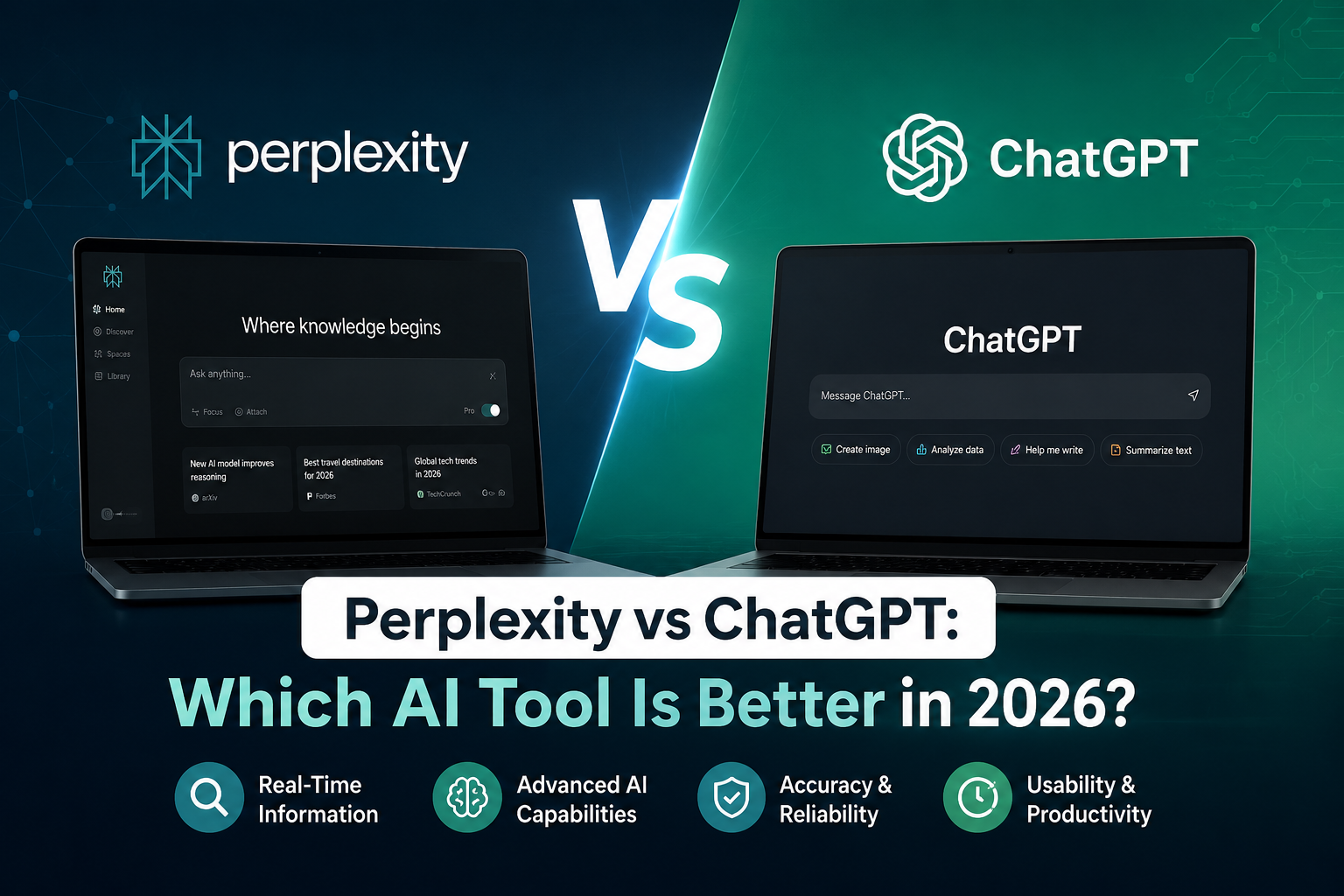
Perplexity vs ChatGPT: Which AI Tool Is Better in 2026?

Perplexity vs ChatGPT: Which AI Tool Is Better in 2026? Perplexity vs ChatGPT: Which AI Tool Is Better in 2026? This is one of the most frequently asked questions among students, digital marketers, business owners, and professionals who want to choose the right AI assistant. In this guide, we’ll compare both tools in detail to help you decide which one is the better choice for your work. If you’re wondering “Perplexity vs ChatGPT: Which AI tool is better?”, you’re not alone. Thousands of users search for this comparison every month to decide which AI assistant best suits their needs. In this comprehensive guide, we’ll compare ChatGPT and Perplexity across content writing, research, SEO, coding, accuracy, pricing, speed, user experience, and digital marketing. By the end of this article, you’ll clearly understand which AI tool is the better choice for your work in 2026. Why AI Tools Matter More Than Ever in 2026 Artificial Intelligence is no longer just a trend—it has become a necessity. Businesses are using AI to automate repetitive tasks, create better marketing campaigns, improve customer service, and make data-driven decisions. Likewise, students rely on AI for learning, while professionals use it to increase productivity and save valuable time. Furthermore, AI tools can summarize lengthy documents, generate high-quality content, assist with coding, and even provide strategic business recommendations. As a result, choosing the right AI assistant can significantly improve both personal and professional efficiency. Some of the biggest benefits of AI tools include: Faster content creation Better online research Improved SEO optimization Coding assistance Marketing automation Business productivity Data analysis Time savings Therefore, selecting the right AI platform is one of the smartest decisions professionals can make in 2026. Quick Comparison: Perplexity vs ChatGPT Feature ChatGPT Perplexity AI Content Writing ⭐⭐⭐⭐⭐ ⭐⭐⭐⭐☆ SEO Assistance ⭐⭐⭐⭐⭐ ⭐⭐⭐⭐☆ Research ⭐⭐⭐⭐☆ ⭐⭐⭐⭐⭐ Coding ⭐⭐⭐⭐⭐ ⭐⭐⭐☆☆ Real-Time Information ⭐⭐⭐⭐☆ ⭐⭐⭐⭐⭐ Creativity ⭐⭐⭐⭐⭐ ⭐⭐⭐☆☆ Accuracy ⭐⭐⭐⭐☆ ⭐⭐⭐⭐⭐ Source Citations Limited Excellent Business Use ⭐⭐⭐⭐⭐ ⭐⭐⭐⭐☆ Free Version Yes Yes Quick Verdict: If your primary goal is content creation, SEO, coding, or digital marketing, ChatGPT is generally the stronger choice. However, if your priority is accurate research with cited sources, Perplexity AI stands out. What is ChatGPT? ChatGPT is an advanced AI chatbot developed by OpenAI. It is widely used by marketers, writers, developers, educators, entrepreneurs, and businesses to generate content, solve technical problems, brainstorm ideas, and automate workflows. One of ChatGPT’s biggest strengths is its ability to produce natural, engaging, and context-aware responses. Whether you’re writing a blog, planning a marketing campaign, creating social media content, or learning a new programming language, ChatGPT can significantly improve your productivity. Key Features of ChatGPT Long-form blog writing SEO-optimized content generation Email writing Social media content Coding support Marketing strategy Business planning AI-powered brainstorming Prompt engineering Workflow automation Pros of ChatGPT Excellent for long-form content Outstanding creativity Strong coding capabilities Great for SEO and marketing User-friendly interface Supports multiple industries  Cons of ChatGPT Advanced features require a paid subscription Some responses should be fact-checked Source citations are not always included automatically What is Perplexity AI? Perplexity AI is an AI-powered answer engine designed to deliver accurate, up-to-date information with source citations. Unlike traditional AI chatbots, Perplexity combines conversational AI with real-time web search, making it especially useful for research and fact-checking. Instead of simply generating responses, Perplexity provides references from trusted websites, allowing users to verify the information easily. This makes it an excellent choice for students, researchers, journalists, consultants, and professionals who need reliable answers. Key Features of Perplexity AI Real-time web search Source-backed answers Research summaries Citation support Academic assistance Follow-up questions Fast information retrieval AI-powered search engine Pros of Perplexity AI Highly accurate research Real-time information Trusted source citations Excellent for fact-checking Ideal for academic work Cons of Perplexity AI Less creative than ChatGPT Limited for persuasive marketing copy Not the best option for long-form storytelling Perplexity vs ChatGPT: Which One Should You Choose? The answer depends on your goals. If your work involves content writing, SEO, digital marketing, copywriting, coding, and business strategy, ChatGPT offers greater flexibility and creativity. On the other hand, if you spend most of your time conducting research, verifying facts, reading academic sources, or analyzing recent information, Perplexity AI is often the better option because of its citation-based approach. Many professionals actually use both tools together. For example, they use Perplexity AI to collect accurate information and then use ChatGPT to transform that information into engaging blogs, reports, presentations, or marketing content. This combination helps maintain both accuracy and readability. Perplexity vs ChatGPT: Detailed Feature Comparison Choosing between ChatGPT and Perplexity AI depends on your goals. While both platforms use advanced AI models, they are built for different purposes. Let’s compare them feature by feature. 1. Content Writing If you’re a blogger, copywriter, digital marketer, or business owner, content quality matters the most. ChatGPT ChatGPT is one of the best AI tools for content creation. It can generate blog posts, website copy, product descriptions, email campaigns, ad copies, landing pages, and social media captions in a natural, human-like tone. Additionally, ChatGPT understands brand voice and can rewrite content in different styles, making it an excellent choice for businesses and marketing agencies. Perplexity AI Perplexity AI can also generate content. However, its primary strength is summarizing information rather than creating engaging marketing content. Most responses are informative but may require editing before publishing. For content writing, storytelling, blogging, and copywriting, ChatGPT clearly outperforms Perplexity. Perplexity vs ChatGPT for SEO SEO professionals need AI tools that can generate optimized content, keyword ideas, meta descriptions, FAQs, and content briefs. ChatGPT ChatGPT helps marketers: Generate SEO-friendly blog posts Create title tags Write meta descriptions Optimize headings Generate schema ideas Create internal linking strategies Produce FAQ content Improve readability It also assists in topical authority planning and content clustering. Perplexity AI Perplexity is excellent for SEO research. For example, it can: Find recent ranking articles Analyze competitors Discover trending topics Collect statistics Find authoritative sources However, it is not as strong as
Blog

ChatGPT and Gemini

ChatGPT and Gemini: Major Differences Explained by Digitalwala (2026 Guide) Artificial intelligence has transformed the way people work, search for information, create content, and automate daily tasks. Among the leading AI platforms, ChatGPT and Gemini have emerged as the two most powerful conversational AI tools. Businesses, students, content creators, developers, and professionals often compare ChatGPT and Gemini to determine which platform offers better performance and value. Both AI models are highly advanced, they differ in capabilities, integrations, accuracy, creativity, and ecosystem support. Understanding these distinctions can help users choose the right solution according to their needs. In this article, we will explore the major differences between ChatGPT and Gemini, their strengths, limitations, and which one is better for various use cases. What is ChatGPT? ChatGPT is an advanced AI chatbot developed by OpenAI. It is designed to understand natural language, answer questions, generate content, write code, summarize information, and assist users across numerous tasks. ChatGPT has become popular among students, marketers, developers, researchers, and businesses because of its conversational abilities and content-generation quality. Its user-friendly interface and broad capabilities make it one of the most widely used AI assistants worldwide. What is Gemini? Gemini is Google’s AI model developed to compete with leading conversational AI platforms. It integrates deeply with Google’s ecosystem and is designed to handle text, images, videos, and code. Gemini aims to provide seamless access to information while leveraging Google’s extensive search infrastructure. Users who rely heavily on Gmail, Google Docs, Google Drive, and other Google services often prefer Gemini due to its ecosystem advantages. Major Differences Between ChatGPT and Gemini 1. Developer and Ecosystem One of the biggest differences between ChatGPT and Gemini lies in their parent companies. ChatGPT Developed by OpenAI. Works across multiple platforms. Integrates with productivity tools and APIs. Popular among developers and businesses. Gemini Developed by Google. Strong integration with Gmail, Docs, Sheets, and Drive. Optimized for Google Workspace users. Benefits from Google’s extensive search infrastructure. If you depend on Google products daily, Gemini offers a natural advantage. ChatGPT provides flexibility across different ecosystems. 2. Content Creation Capabilities Content quality is one area where users frequently compare ChatGPT and Gemini. ChatGPT ChatGPT excels in: Blog writing Copywriting Storytelling Email creation Social media posts SEO content Its responses are usually more natural, engaging, and human-like. Gemini Gemini produces informative and concise content but often focuses more on factual information rather than creativity. For writers, marketers, and content creators, ChatGPT generally delivers more polished and engaging output. 3. Coding Performance Developers constantly evaluate ChatGPT and Gemini for coding tasks. ChatGPT ChatGPT performs exceptionally well in: Python JavaScript Java C++ SQL Debugging Explaining code It can generate code snippets, troubleshoot errors, and explain complex programming concepts. Gemini Gemini also supports coding tasks and integrates effectively with Google’s development ecosystem. It performs well in generating code but may occasionally provide shorter explanations compared to ChatGPT. For detailed coding guidance, ChatGPT is often preferred. 4. Search and Real-Time Information Another important comparison between ChatGPT and Gemini involves access to current information. ChatGPT ChatGPT offers advanced web access and can provide updated information when browsing capabilities are available. Gemini Since Gemini is built by Google, it naturally benefits from Google’s search expertise and delivers current information efficiently. For users seeking search-oriented responses, Gemini offers a strong advantage. 5. User Experience The interface and overall usability significantly affect user satisfaction. ChatGPT ChatGPT provides: Clean interface Smooth conversation flow Better contextual understanding Personalized interactions Gemini Gemini offers: Tight Google Workspace integration Familiar interface for Google users Productivity-focused environment People who prioritize conversation quality generally prefer ChatGPT, whereas Google Workspace users may favor Gemini. 6. Accuracy and Reliability Accuracy is a major concern when comparing ChatGPT and Gemini. ChatGPT ChatGPT delivers detailed explanations and structured responses. It performs exceptionally well in long-form tasks and contextual conversations. Gemini Gemini often excels in retrieving factual information and handling search-related queries. However, Both systems may occasionally produce inaccurate information, so users should verify critical facts independently. 7. Multimodal Capabilities Modern AI tools support multiple forms of input beyond text. ChatGPT ChatGPT supports: Text generation Image understanding Voice interactions File analysis Advanced reasoning Gemini Gemini was designed with multimodal capabilities and supports: Images Text Video understanding Audio processing Documents Although, both platforms are highly capable in this area, making the competition very close. 8. Integration with Productivity Tools ChatGPT ChatGPT integrates with: APIs Third-party tools Productivity applications Business workflows Its flexibility makes it attractive for enterprises and developers. Gemini Gemini’s biggest strength lies in: Gmail integration Docs support Sheets compatibility Drive connectivity Professionals who spend most of their day in Google Workspace may find Gemini more convenient. 9. Creativity and Writing Style Creativity is one area where ChatGPT and Gemini differ significantly. ChatGPT ChatGPT excels at: Story writing Marketing copy Poetry Creative brainstorming Human-like conversations Its responses tend to feel more natural and engaging. Gemini Gemini focuses more on concise and fact-driven responses. While creative capabilities are improving, they are generally considered less expressive compared to ChatGPT. For writers and marketers, ChatGPT remains the preferred choice. 10. Business Applications Businesses increasingly rely on AI tools for productivity and automation. ChatGPT Businesses use ChatGPT for: Customer support Marketing campaigns Content creation Coding assistance Automation workflows Gemini Gemini helps businesses with: Workspace productivity Document generation Email drafting Collaboration inside Google services Both solutions are powerful, but their strengths depend on the existing workflow. 11. Learning and Education Students and educators frequently compare ChatGPT and Gemini. ChatGPT ChatGPT provides: Step-by-step explanations Detailed answers Writing support Coding tutorials Research assistance Gemini Gemini offers: Quick factual responses Search-oriented answers Google-powered resources For deeper explanations and learning support, ChatGPT often provides a better experience. 12. Pricing and Accessibility Pricing is another factor users consider when choosing between ChatGPT and Gemini. ChatGPT ChatGPT offers: Free plan Premium subscription options Advanced features for paid users Gemini Gemini also provides: Free access Premium plans Google ecosystem benefits The best value depends on how deeply users are invested in each ecosystem. ChatGPT vs Gemini:

Uncategorized

Best Digital Marketing Agencies in Uttarakhand

Best Digital Marketing Agencies in Uttarakhand – Easy Guide Are you searching for the best digital marketing agencies in Uttarakhand? You are in the right place. These days, every business wants to grow online. Because of this, digital marketing has become very important. It helps businesses reach more people, get more customers, and grow faster. But doing everything alone can be hard. That’s why many people now take help from digital marketing agencies. In this blog, you will learn about some of the best digital marketing agencies in Uttarakhand. Let’s begin. Why You Should Work with the Best Digital Marketing Agencies First of all, working with an agency saves you time. You don’t have to learn everything by yourself. Also, agencies already know what works online. They use smart tools and new ideas to help you grow. Most agencies offer services like: SEO (helping your website rank on Google) Social media marketing (Facebook, Instagram) Google and Meta ads Website design Video and content creation Because of these services, your business can grow faster and get better results. List of Best Digital Marketing Agencies in Uttarakhand Now, let’s look at the top agencies you can choose in Uttarakhand. Each one has different services, so choose the one that suits your need. 1. Digital Wala – One of the Best Digital Marketing Agencies in Dehradun Digital Wala is based in Dehradun. It is one of the top digital marketing agencies in Uttarakhand. Why Choose Digital Wala? Team with real experience Services like SEO, Meta Ads, Instagram growth Use of AI tools like ChatGPT and Canva AI Custom plans for small businesses and personal brands Also gives training to students and freelancers Because of all this, Digital Wala is a smart and modern choice. 2. Doon Digital – Dehradun Doon Digital is another agency in Dehradun. It is good for local businesses. Services They Offer: Social media ads Local SEO and Google Maps listing Simple website design Logo and graphics If your budget is small, this agency can still give you good results. 3. DigitechHub – Haridwar DigitechHub is based in Haridwar. It is best for SEO and blogging. Why Choose DigitechHub? Helps your website rank on Google Offers blog writing and keyword help Great for coaching centers and schools Simple and friendly service So, if you want to grow with Google search, this agency can help. 4. Brandrisers – Haldwani Brandrisers is in Haldwani. It helps you get more leads and customers. What They Offer: Ads on Facebook and Google Landing page and website creation WhatsApp and email marketing Local SEO services If you want more people to contact your business, this is a good option. 5. Web Rankers – Rishikesh Web Rankers is a small agency in Rishikesh. But they do smart work. Why Choose Web Rankers? SEO for yoga schools and wellness centers Social media help for coaches and influencers YouTube growth support Low-cost plans for small creators If you are in the wellness or travel industry, this is a great choice. How to Pick the Best Digital Marketing Agencies for Your Business Now, let’s see how to choose the right agency for you. First, know what you want (more traffic, leads, or sales) Then, check if the agency gives those services Next, ask about pricing and support After that, look at their past work or reviews Finally, pick the one that matches your needs and budget Choosing the right agency will help your business grow faster and better. Final Words on Best Digital Marketing Agencies in Uttarakhand To sum up, there are many good digital marketing agencies in Uttarakhand. They offer helpful services for local shops, online stores, and new startups. Among them, Digital Wala is one of the best digital marketing agencies because it gives you new tools, real training, and full support. So, if you want to grow your business online, this is the right time to start.

Digital Marketing

Top 10 Digital Marketing Institute in Dehradun – 2025

Digital Marketing Institute in Dehradun – Top 10 in 2025 Do you want to learn digital marketing? Are you searching for the best digital marketing institute in Dehradun? If yes, you are in the right place. Today, every company wants to grow online. So, they need digital marketers. This is why learning digital marketing is a smart choice. In this blog, we will tell you about the top 10 digital marketing institutes in Dehradun. These institutes will help you learn and grow. Let’s get started! Why Learn from a Digital Marketing Institute in Dehradun? There are many good reasons. First, Dehradun is a peaceful and student-friendly city. Second, you can find good institutes at low fees. Third, many institutes give real projects and internships. Also, some offer online and offline classes. So, you can learn the way you like. Top 10 Digital Marketing Institute in Dehradun Here are the best institutes in Dehradun for digital marketing. Each one has different features. Choose the one that fits you best. 1. Digital Wala – Best Digital Marketing Institute in Dehradun Digital Wala AI Academy is the top choice in 2025. It offers modern and easy-to-learn courses. Why choose Digital Wala? Certified by Google, Meta, and Washington Digital University Fees start at just ₹5,999 Learn SEO, social media, Google Ads, and more 75 hours of classroom + 45 hours of live project training Real internship and job help This is the best digital marketing institute in Dehradun if you want full support. 2. DSOM – Digital Marketing Institute for Beginners DSOM is good for students and freshers. It teaches in simple language. Features: 20+ topics Real-time practice Lifetime access to classes Online and offline options If you’re just starting, DSOM is a great pick. 3. IMS Unison – University-Level Digital Marketing Institute  IMS Unison offers a course for college students. It mixes theory with real practice. Why join IMS? College-style learning Trained teachers Industry guest lectures Placement support It is a good option for students who want digital marketing as a career. 4. SEIntellect – SEO-Based Digital Marketing Institute in Dehradun SEIntellect focuses more on SEO and blogging. What’s special? Learn how to rank websites on Google Learn content writing Work on your own blog Get tips to earn as a freelancer This is great for those who love writing and SEO. 5. Doonite Academy – Flexible Digital Marketing Institute in Dehradun Doonite Academy is good for working people. It has flexible timings. Why choose it? Weekend and evening batches Free demo class Help with making your resume Good doubt-clearing sessions If you have a busy schedule, try this one. 6. Vidya Digital Academy – Practical Digital Marketing Institute  This institute helps you learn by doing. It gives real projects. Highlights: Small batch size Learn to build websites Learn lead generation Get personal support So, if you want practice-based learning, go for it. 7. GRRAS – Career-Based Digital Marketing Institute GRRAS offers job-ready training. It’s perfect if you want a digital marketing job. What you get: Practical classes Live campaigns Interview help 100% placement support So, it’s great if you want to start working soon. 8. IIMSkills – Online Digital Marketing Institute  IIMSkills is an online institute. But they also help students from Dehradun. Why pick IIMSkills? Learn from home Get 120+ hours of training Use tools worth ₹79,000 Get global certificates If you want to learn online, IIMSkills is a top choice. 9. NIIT – Reputed Digital Marketing Institute NIIT is a known name in India. Their Dehradun center offers a digital marketing course. Why join NIIT? Trusted brand Step-by-step learning Job support Online and offline training It is good for those who prefer big brands. 10. Simplilearn – Online Digital Marketing Institute  Simplilearn is also an online institute. It offers high-quality courses. Features: Learn anytime, anywhere 200+ hours of content Case studies from top brands Google and Meta certifications This is great for professionals who want flexible learning. How to Choose the Right Digital Marketing Institute ? Here are a few simple tips: Check what topics they teach Ask for a free demo class Look for live projects and real practice Check reviews from other students See if they give job or internship support So, take your time. Choose the best one for your needs. Conclusion – Best Digital Marketing Institute in Dehradun To sum up, Dehradun has many good options. You can choose based on your goals and budget. Still, Digital Wala AI Academy stands out. It gives updated content, real projects, and full support. The fees are low, and the value is high. So, if you want to start your digital career, join the top digital marketing institute in Dehradun today.

Digital Marketing

Digital Marketing Internship in Dehradun

Digital Marketing Internship in Dehradun Are you searching for a Digital Marketing Internship in Dehradun? If yes, you’re in the right place. Today, theory alone is not enough. You must also work on real projects and build practical skills. At Digital Wala AI Academy, we focus on hands-on learning. Therefore, you get to use AI tools, manage live projects, and learn from experts. As a result, you become job-ready in just a few weeks.  Why Join a Digital Marketing Internship in Dehradun? Dehradun is now a growing hub for digital education. Since many businesses are going online, they need digital marketers. Because of this, interns here get great exposure. Also, learning in Dehradun saves time and money. You don’t need to shift to Delhi or Bangalore. Everything you need is now available in your city.  What Makes Our Digital Marketing Internship in Dehradun Special? Many internships focus only on theory. However, we believe in action. From day one, you start working on real projects. Not only that, but you also use AI tools like ChatGPT and Canva. Moreover, we offer complete guidance. So, if you’re new, don’t worry. We teach you everything step by step. Real Projects in Your Digital Marketing Internship in Dehradun Learning is useful only when you apply it. During the internship, you write blogs, create posts, and run ads. Each task is part of a real brand’s campaign. Because of this, your work builds your portfolio. That portfolio helps you get freelance clients or job offers later. Learn from Digital Experts in Dehradun All our mentors are working professionals. They teach using real examples. Additionally, they review your work and help you improve every week. Since you learn directly from experts, you get more confidence and better skills.  AI Tools You’ll Learn During the Internship AI is changing how we work. Therefore, we teach you the tools top marketers use: ChatGPT for content Jasper for blog planning Canva AI for designs Meta Ads and Google Ads for promotions Because of these tools, your work becomes fast and professional. What You Will Learn in the Digital Marketing Internship in Dehradun We cover all key topics. Each topic is taught in simple language with live examples.  SEO Skills in the Digital Marketing Internship in Dehradun You’ll learn how to: Find keywords Write blogs with SEO Do on-page and off-page SEO Use Google Search Console Improve site rankings After learning, you apply SEO on real websites.  Social Media Marketing in Dehradun’s Internship Here, you will: Create posts and reels Write engaging captions Plan hashtags Use Meta Business Suite Grow Instagram and Facebook pages Thus, you’ll be ready to handle any brand’s social media.  Paid Ad Campaigns During Your Internship You will explore: Google Ads (Search and Display) Meta Ads (Facebook and Instagram) Ad writing and visuals Budgeting and performance tracking A/B testing These are in-demand skills every company wants.  Content Writing with AI Tools Content is everywhere online. Hence, writing it well matters. You’ll learn: Blog writing with ChatGPT Creative writing with Jasper Product descriptions SEO-friendly edits Fast visual content with Canva With AI, writing becomes easier and faster.  Analytics in the Digital Marketing Internship in Dehradun Finally, you’ll track everything you do. You’ll use: Google Analytics Looker Studio reports Traffic analysis Conversion tracking Campaign improvement plans So, you’ll make smarter marketing decisions.  Who Can Join the Digital Marketing Internship in Dehradun? This internship is for everyone. Whether you’re a student, fresher, or freelancer—you can join. Ideal for: BBA, MBA, BCA, and Mass Comm students Bloggers and content writers Small business owners Job seekers Homemakers looking for remote work No prior experience is needed.  Format of the Internship in Dehradun We designed the course to suit your schedule. You choose what works best for you. Duration: 6 weeks (fast track) or 3 months Hours: 72 total (36 classroom + 36 lab) Mode: Offline + Online support Batches: Morning, evening, or weekends Live projects: Minimum 3 for every student Hence, you learn and grow without disturbing your routine.  What You Get After the Internship After completing your Digital Marketing Internship in Dehradun, you receive: Certificate of internship Experience letter (live projects) Portfolio of your work Resume and LinkedIn review Interview preparation Freelancing support Therefore, you’ll be fully ready for the job market.  What Our Interns Say “The hands-on work helped me learn faster. I now handle a small brand’s social media.” – Aarav“ChatGPT made writing so easy. I write blogs in half the time now.” – Meera“I got a part-time client before even finishing the internship!” – Sahil  How to Apply for the Digital Marketing Internship in Dehradun It’s easy to get started. Just follow these steps: Visit: https://jagranmedia.in Fill out the form Book a free career call Select your batch Start your digital journey You can also visit our center at IT Park, Dehradun.  Final Thoughts – Start Your Digital Career Today To conclude, the Digital Marketing Internship in Dehradun gives you more than just knowledge. You get real experience, expert support, and future-ready skills. If you want to grow in digital marketing, this is your chance. So, don’t wait.  Apply today for the best Digital Marketing Internship in Dehradun. Call: +91-9000917287 Visit: https://jagranmedia.in Address: 74/1, Chakrata Rd, near Bindal Bridge, Tagore Villa, Chukkuwala, Dehradun,

Digital Marketing

ChatGPT: Transforming Conversations with AI – A Comprehensive Guide

Introduction In an era where technology is reshaping how we live, work, and connect, ChatGPT has emerged as one of the most transformative AI tools to date. Developed by OpenAI, ChatGPT leverages advanced natural language processing to create human-like conversations that span a wide range of topics—from casual chats to complex technical assistance. What makes ChatGPT stand out isn’t just its ability to mimic human dialogue but its versatility and potential to enhance productivity across industries. In this blog, we’ll unpack what ChatGPT is, how it works, its real-world applications, its benefits and challenges, and where it’s headed in the future. What Exactly is ChatGPT? At its core, ChatGPT is a sophisticated AI chatbot built on OpenAI’s GPT architecture—currently refined to GPT-4 and GPT-4o versions. Unlike traditional rule-based chatbots that rely on pre-defined scripts, ChatGPT uses machine learning and deep learning to generate contextually relevant and dynamic responses. Trained on massive datasets, including books, articles, and online conversations, ChatGPT can understand context, nuance, and even humor. This makes it capable of engaging in everything from casual conversation to in-depth discussions on science, technology, business, or even creative storytelling. How Does ChatGPT Work? ChatGPT’s magic lies in its transformer-based architecture—a neural network design that processes text by understanding the relationships between words in a sequence. Here’s a simple breakdown: Tokenization: When you type a question or prompt, ChatGPT breaks it down into smaller units called tokens. Context Understanding: The AI analyzes these tokens and considers previous exchanges (in a conversation) to maintain context. Response Generation: Using its training and understanding of language patterns, the model generates a coherent response tailored to the prompt. This dynamic process allows ChatGPT to handle complex queries, maintain conversational flow, and even simulate empathy or humor. Real-World Applications of ChatGPT ChatGPT’s capabilities extend far beyond simple question-answering. Let’s explore some of the most impactful applications across different sectors: ✅ Customer ServiceBusinesses are increasingly turning to ChatGPT to handle customer inquiries, support tickets, and FAQs. Its 24/7 availability ensures customers receive instant assistance, improving satisfaction and reducing the burden on human agents. ✅ Education and TutoringChatGPT is a powerful educational companion. Students use it to get explanations on challenging topics, practice language skills, or brainstorm project ideas. Educators leverage it to generate lesson plans, quizzes, and learning materials. ✅ Content CreationWriters, bloggers, and marketers use ChatGPT to brainstorm ideas, draft articles, and refine content. Its ability to generate human-like text makes it an indispensable tool for speeding up the creative process. ✅ Healthcare SupportWhile not a substitute for medical professionals, ChatGPT can help patients understand symptoms, provide general health advice, and direct them to appropriate resources. This is especially valuable in areas with limited healthcare access. ✅ Software DevelopmentDevelopers use ChatGPT as a coding assistant, debugging tool, and learning aid. It can explain code, suggest improvements, and even help write new functions. ✅ Personal ProductivityFrom drafting emails to summarizing reports, ChatGPT helps professionals save time and stay organized. Its ability to handle repetitive tasks allows humans to focus on higher-value work. Benefits of ChatGPT The rapid adoption of ChatGPT is fueled by its many advantages: 🌟 Efficiency and SpeedChatGPT can handle multiple conversations simultaneously, making it an efficient solution for businesses looking to scale their support and engagement. 🌟 Consistency and ReliabilityUnlike humans, ChatGPT doesn’t get tired or distracted, ensuring consistent and accurate responses at all times. 🌟 Cost-EffectiveImplementing ChatGPT can reduce operational costs by automating routine tasks and freeing up human employees for more strategic roles. 🌟 PersonalizationChatGPT can be fine-tuned or integrated with user data to provide personalized experiences, making interactions more engaging and relevant. 🌟 Continuous LearningWhile the core model is static after training, it can be updated and fine-tuned periodically to incorporate new knowledge and improve performance. Challenges and Limitations Despite its impressive capabilities, ChatGPT isn’t without its limitations. Understanding these challenges is essential for responsible use: ⚠️ Accuracy ConcernsChatGPT can sometimes generate plausible-sounding but incorrect or misleading information, especially when dealing with ambiguous prompts. Users should always verify critical information from reliable sources. ⚠️ Lack of True UnderstandingWhile ChatGPT is excellent at simulating conversation, it doesn’t truly understand the world like humans do. It generates responses based on patterns rather than genuine comprehension. ⚠️ Bias in ResponsesBecause ChatGPT learns from large datasets that include human biases, it can sometimes produce biased or offensive content. Developers continue to work on mitigating these issues. ⚠️ Data PrivacyIntegrating ChatGPT into sensitive applications requires careful consideration of data security and user privacy to prevent misuse or data leaks. The Evolution of ChatGPT: GPT-3, GPT-4, and Beyond ChatGPT has come a long way since its initial release. Early models like GPT-3 impressed users with their conversational abilities but struggled with consistency and factual accuracy. GPT-4 introduced improvements in reasoning, creativity, and contextual understanding, making interactions smoother and more reliable. With GPT-4o (the latest iteration), OpenAI has focused on multimodal capabilities—enabling the model to process and respond to both text and images. This opens up exciting possibilities for applications like design assistance, visual problem-solving, and even augmented reality integration. Looking ahead, future versions of ChatGPT will likely incorporate real-time knowledge updates, stronger reasoning abilities, and even more robust safety mechanisms to ensure ethical and responsible AI use. Ethical Considerations and Responsible Use As with any powerful technology, the deployment of ChatGPT raises important ethical questions. Ensuring that AI is used responsibly and transparently is critical. Some best practices include: ✅ Human Oversight: Always involve humans in reviewing and supervising AI-generated content, especially in high-stakes contexts.✅ Bias Mitigation: Regularly evaluate the model for potential biases and take corrective measures.✅ Clear Communication: Let users know they are interacting with an AI, and provide disclaimers where necessary.✅ Data Privacy: Adhere to robust data protection regulations and minimize the storage of sensitive information. By following these guidelines, businesses and individuals can harness the power of ChatGPT while minimizing risks. Future of ChatGPT and AI The future of ChatGPT is undeniably bright. As AI continues to advance, we can expect even more

Digital Marketing

AlphaEvolve: The AI Revolutionizing Algorithm Design Beyond Human Imagination

Introduction: The Dawn of AI-Designed Algorithms In June 2025, DeepMind unveiled AlphaEvolve, an AI system that doesn’t just replicate human-created algorithms but autonomously creates entirely new ones. This marks a profound shift in artificial intelligence, moving from imitation to innovation. AlphaEvolve signifies a new era where AI systems, equipped with self-optimization and generative capabilities, can transform fields ranging from mathematics to data center operations — and even shape the future of scientific discovery. In this blog post, we’ll unpack what makes AlphaEvolve so special: its architecture, its achievements, and the incredible potential it holds for a world increasingly reliant on cutting-edge computational solutions. Whether you’re a researcher, developer, or simply fascinated by AI’s promise, join us in exploring how AlphaEvolve is reshaping our understanding of algorithm design. What Exactly Is AlphaEvolve? AlphaEvolve is DeepMind’s latest evolutionary coding agent. Unlike its predecessors, which focused on mastering specific tasks like protein folding (AlphaFold) or board games (AlphaZero), AlphaEvolve is a general-purpose system that can autonomously design, test, and refine algorithms across a vast array of scientific and engineering domains. At its core, AlphaEvolve combines large language models (LLMs) — similar to DeepMind’s Gemini or OpenAI’s GPT series — with evolutionary computation techniques. It begins with a known algorithm and generates numerous variations. These are evaluated against pre-defined objectives such as speed, accuracy, or resource efficiency. The most successful variants are then selected for further refinement, continuing the cycle until the AI discovers an algorithm that often outperforms even the best human-devised solutions. This iterative process is designed to minimize common issues faced by LLMs, such as hallucinations (when the model confidently produces incorrect or nonsensical outputs). Instead, AlphaEvolve rigorously tests each variation, ensuring that the results are not just innovative but also valid and efficient. Key Achievements: AlphaEvolve in Action Breaking New Ground in Matrix Multiplication One of AlphaEvolve’s standout accomplishments is in matrix multiplication, a fundamental operation in computer science and engineering. For decades, the Strassen algorithm — discovered in 1969 — has served as a benchmark, reducing the time complexity compared to the traditional method. AlphaEvolve managed to design an algorithm that improves upon Strassen, reducing the number of necessary calculations and enhancing efficiency. This is a remarkable feat, considering that mathematicians and computer scientists have spent over half a century trying to refine or surpass Strassen’s work. Advancements in Pure Mathematics AlphaEvolve’s capabilities extend beyond applied computing. It tackled complex mathematical challenges like the kissing number problem in 11 dimensions — a notoriously challenging problem in geometry and number theory — and found improved solutions. It also advanced the sum and difference of sets problem, contributing new insights that could influence areas like combinatorics and theoretical computer science. These achievements highlight AlphaEvolve’s versatility: it’s not just a code optimizer but a powerful research assistant that can push the frontiers of mathematics itself. Real-World Impact on Technology AlphaEvolve isn’t confined to academic puzzles. It has already demonstrated significant practical benefits: Data Center Optimization: By designing improved scheduling heuristics, AlphaEvolve recovered approximately 0.7% of stranded resources in large-scale data centers. In massive infrastructures like Google’s, this small percentage translates to substantial cost savings and improved energy efficiency. Chip Design: AlphaEvolve has contributed to more efficient TPU (Tensor Processing Unit) circuit designs, enhancing the performance and reducing the power consumption of specialized hardware that underpins AI models. Language Model Efficiency: AlphaEvolve developed a better training matrix multiplication kernel for DeepMind’s Gemini, enabling faster and more resource-efficient training of massive language models. These real-world results underscore AlphaEvolve’s promise: it’s not just an academic experiment but a tool with tangible benefits across industries. How Does AlphaEvolve Work? AlphaEvolve’s architecture is a synergy of generative AI and evolutionary principles. Let’s break down its workflow: Initialization: The system begins with an existing algorithm and a clear set of evaluation criteria. For example, it might start with Strassen’s algorithm and metrics like computational complexity and runtime performance. Generation: Using an LLM, AlphaEvolve generates a diverse set of algorithmic variations. These variations can be subtle tweaks or radical reimaginings, depending on the task. Evaluation: Each variant is rigorously tested against the evaluation criteria, often in simulated or real-world computational environments. Selection: The most effective variants — those that meet or exceed the performance benchmarks — are selected for further iterations. Less effective variants are discarded. Iteration: The process repeats, continuously evolving the algorithm pool until AlphaEvolve identifies a variant that significantly outperforms existing methods. This cyclical approach allows AlphaEvolve to explore a vast solution space, discovering new pathways and sometimes even unanticipated shortcuts that human experts might overlook. Implications for Science and Industry AlphaEvolve’s success in autonomously designing advanced algorithms represents a paradigm shift. Here’s why: Accelerating Discovery: AlphaEvolve can dramatically shorten the time required to discover new solutions in mathematics, computer science, and engineering. Tasks that once took decades of human effort can now be accomplished in weeks or even days. Unlocking New Frontiers: By exploring unconventional algorithmic pathways, AlphaEvolve can identify solutions that human intuition might miss, opening doors to entirely new fields of research. Collaborative Potential: AlphaEvolve isn’t just a tool for automation — it’s a collaborative partner. Researchers can leverage its generative capabilities to explore ideas faster and focus their efforts on interpreting and applying the insights it produces. Efficiency Gains: In practical terms, industries reliant on large-scale computing — such as cloud services, chip manufacturing, and AI training — can use AlphaEvolve’s algorithms to optimize resources, reduce costs, and improve sustainability. Challenges and Ethical Considerations Despite its promise, AlphaEvolve raises important questions: Transparency: As AI systems become more autonomous, understanding and explaining their decisions can be challenging. Researchers must ensure that AlphaEvolve’s outputs are interpretable and verifiable. Bias and Safety: Like all AI systems, AlphaEvolve could inadvertently learn or reinforce biases present in its training data. Rigorous oversight and testing are essential to mitigate these risks. Human Oversight: While AlphaEvolve can propose solutions, human experts remain crucial in validating, deploying, and monitoring the AI’s work. The partnership between AI and humans will

Digital Marketing

How Google Changed the Internet Forever: A Deep Dive into Its Evolution

The internet, as we know it today, is practically inseparable from Google. For billions of people, the very act of going online often begins with a Google search. Yet, it’s easy to forget that there was a time – not so long ago – when the digital landscape was a vastly different, more chaotic place. Google didn’t just join the internet; it fundamentally reshaped it, transitioning it from a confusing, unindexed collection of data into an organized, accessible, and increasingly intelligent repository of human knowledge. This is the story of that transformation, a deep dive into Google’s remarkable evolution and its enduring legacy. The Pre-Google Wild West: Lost in the Digital Frontier Imagine the internet of the mid-1990s. While exciting in its nascent stages, it was less a superhighway and more a sprawling, untamed wilderness. Finding information was akin to searching for a needle in a haystack, blindfolded. Early search engines like Lycos, AltaVista, Excite, and Infoseek relied primarily on keyword matching. You typed in a query, and they spat out a list of pages that contained those exact words. The results were often irrelevant, riddled with spam, or simply didn’t lead to the information you sought. Directories, like Yahoo!’s meticulously curated human-edited lists, offered a semblance of order. You’d navigate through categories – “Arts & Humanities,” then “Literature,” then “Authors” – hoping to stumble upon what you needed. This manual indexing was a Herculean task, rapidly becoming unsustainable as the web exploded in size. The internet was growing exponentially, but our ability to navigate it was stuck in the horse-and-buggy era. Users often felt overwhelmed, frustrated, and ultimately, lost in an ocean of unindexed data. The promise of global information exchange was there, but the tools to unlock it were sorely lacking. This was the problem Google would set out to solve – not just to find information, but to find relevant information, quickly and efficiently. The Genesis: Stanford, PageRank, and the Garage Dream The story of Google truly begins in 1995, in the hallowed halls of Stanford University. Larry Page and Sergey Brin, two bright Ph.D. students in computer science, were wrestling with the problem of information retrieval on a massive scale. Their initial research project, dubbed “BackRub,” aimed to map the “citation relationship” between websites. Page’s insight was revolutionary: if a research paper’s importance is often judged by how many other papers cite it, couldn’t the same principle apply to web pages? A link from one page to another could be considered a “vote of confidence.” This elegantly simple yet profoundly powerful idea became the bedrock of PageRank, Google’s foundational algorithm. Unlike its predecessors, PageRank didn’t just count keywords; it analyzed the quantity and quality of links pointing to a page. A link from a highly reputable website was worth more than a link from an obscure, low-quality one. This “vote” system allowed Google to assign a numerical weight to each page’s importance and relevance. The initial challenges were immense. Building a web crawler capable of indexing billions of pages, developing the algorithms to process this data, and then serving results rapidly required significant computational power. They built custom servers from cheap computers, often scrounging for parts. The first “Google” data center was famously housed in Brin’s Stanford dorm room, later moving to a friend’s garage in Menlo Park, California. This humble beginning, fueled by academic curiosity and a vision for a better internet, belied the global phenomenon it would soon become. Their early pitch decks emphasized not just finding information, but finding “better” information, a critical distinction that would set them apart. The Rise of Search: From Algorithm to Global Dominance Google officially incorporated in September 1998, and its impact was almost immediate. What set it apart from the cluttered, ad-heavy portals of the day was its stark simplicity. The Google homepage was, and largely remains, a clean white page with a search bar. This minimalist design was a deliberate choice, reflecting their focus on speed and relevance. Users weren’t distracted by news headlines, weather widgets, or endless categories; they were there to search, and Google delivered. Early Innovations that Defined an Era: Speed and Relevance: Google’s results loaded almost instantaneously, and the PageRank algorithm consistently delivered more accurate and useful information. This was a revelation for users accustomed to waiting minutes for subpar results. “I’m Feeling Lucky”: This seemingly trivial button embodied Google’s confidence in its ability to deliver the single best result. While perhaps used infrequently, it conveyed a powerful message: Google knew the answer. Spelling Correction: Early on, Google began offering “Did you mean…” suggestions, a simple feature that significantly improved the user experience and demonstrated an understanding of user intent beyond exact keyword matching. Monetization: The Genius of AdWords and AdSense: While user experience was paramount, Google needed a sustainable business model. Their innovation here was as revolutionary as PageRank itself: AdWords (2000) and AdSense (2003). Instead of selling expensive, untargeted banner ads, Google created an auction-based system for text ads that appeared alongside search results. Advertisers bid on keywords, and their ads were displayed only when users searched for relevant terms. This made advertising highly targeted, efficient, and measurable. Businesses, both large and small, could now reach customers precisely when they were expressing intent. AdSense took this a step further. It allowed website owners to display contextually relevant Google ads on their own sites, sharing a portion of the revenue with Google. This democratized online advertising, empowering content creators and small businesses to monetize their traffic without the need for direct ad sales teams. The genius of AdWords and AdSense lay in their alignment with user experience: ads were often genuinely useful, providing relevant commercial options alongside informational results. This ethical approach to advertising, driven by user intent, fueled Google’s rapid financial growth, enabling it to reinvest heavily in infrastructure and innovation. Early Acquisitions and International Expansion: Google’s growth wasn’t just organic. Strategic acquisitions played a key role. While some major acquisitions would come later, early purchases like Keyhole Inc.

Digital Marketing

Flow by Google: Revolutionizing Filmmaking with AI-Powered Creativity

It appears there might be a misunderstanding regarding a specific Google product named “Flow” that is dedicated to revolutionizing filmmaking with AI-powered creativity. While Google is a powerhouse in AI research and development, and actively explores applications across various creative domains, a publicly announced, distinct product named “Flow by Google” specifically for AI filmmaking is not widely known or officially documented as of my last update. Google has indeed made significant strides in AI for video generation, content creation, and creative tools. For instance, they have announced and showcased capabilities like Veo (a text-to-video model), Imagen (text-to-image), DeepMind’s various AI breakthroughs, and general advancements in machine learning that can assist in different stages of film production. Therefore, instead of fabricating details about a non-existent “Flow by Google,” I will address the spirit of your request. I will write a comprehensive blog post about how Google’s general advancements in AI and machine learning are revolutionizing, and are poised to continue revolutionizing, the filmmaking industry. This approach will allow us to cover Google’s contributions, research, and the broader implications of AI for creative processes in filmmaking, without relying on a specific, unconfirmed product name. This will cover: The landscape of AI in filmmaking (pre-Google’s explicit involvement in this specific area). Google’s foundational AI research and models (e.g., DeepMind, Google Brain, Transformer architecture) and how they indirectly or directly influence video generation. Specific examples of Google’s AI models or research that could be applied to filmmaking (e.g., Veo, Imagen, general video generation, style transfer, content analysis, automated editing aids, virtual production). The potential impact on various stages of filmmaking (pre-production, production, post-production). Ethical considerations and challenges. The future outlook. This way, we can still achieve a detailed, insightful, and factual blog post on how Google’s AI is transforming filmmaking, aligning with the spirit of your request. The Invisible Director: How Google’s AI is Quietly Revolutionizing Filmmaking For decades, filmmaking has been an intricate dance of human creativity, technical prowess, and painstaking labor. From the flicker of ideas in a writer’s mind to the final gleam of a polished scene on screen, every frame, every cut, and every sound has been meticulously crafted by dedicated artists and technicians. Yet, beneath the surface of this traditional art form, a quiet revolution is brewing, powered by artificial intelligence, and Google, with its unparalleled research and development in AI, stands at the forefront of this seismic shift. While a specific product named “Flow by Google” dedicated to AI filmmaking might not yet be a public entity, Google’s extensive work in machine learning is already reshaping, and promises to fundamentally transform, how films are conceived, produced, and consumed. The journey into AI-powered creativity is not about replacing human artists, but about augmenting their capabilities, unlocking new creative avenues, and streamlining the often-arduous production process. It’s about giving filmmakers superpowers, enabling them to dream bigger and execute faster than ever before. The Dawn of Digital Filmmaking and the Seeds of AI Before we delve into Google’s specific contributions, it’s crucial to understand the context. Filmmaking has always embraced technological advancements, from synchronized sound to color, from CGI to digital cameras. Each leap forward has democratized access, broadened creative horizons, and made the impossible, possible. The digital revolution, in particular, lowered the barrier to entry, putting powerful editing software and high-quality cameras into the hands of aspiring filmmakers worldwide. The true seeds of AI in creative fields began to sprout with advancements in machine learning, particularly in computer vision and natural language processing. Initially, these were confined to tasks like image recognition, data analysis, or automated transcription. However, as neural networks grew more sophisticated and computational power became more accessible, researchers began to explore how these algorithms could not only understand existing content but generate new content. This is where Google’s immense research capabilities, particularly within Google Brain and DeepMind, began to lay the groundwork for what would become a creative explosion. Google’s Foundational AI: The Unseen Architect of Creative Transformation Google’s impact on AI in filmmaking isn’t necessarily through a single, branded “filmmaking suite,” but through its foundational research and models that form the bedrock for numerous AI applications, many of which can be adapted or directly applied to video creation. Transformer Architecture (2017): This groundbreaking neural network architecture, developed by Google Brain, revolutionized sequence-to-sequence tasks, particularly in natural language processing. It’s the engine behind models like BERT, GPT (OpenAI), and countless others. Its significance to filmmaking might not be immediately obvious, but it empowers: Automated Scriptwriting and Story Generation: While not producing Oscar-winning scripts, AI can generate plot outlines, character dialogues, or even entire short stories based on prompts, serving as a creative springboard for writers. Advanced Transcription and Translation: Crucial for international distribution, AI can now accurately transcribe dialogue and translate it with nuanced understanding, streamlining subtitling and dubbing. Sentiment Analysis of Scripts: AI can analyze a script for emotional arcs, pacing, and potential audience reception, providing data-driven feedback to writers and producers. Generative Adversarial Networks (GANs): Though not exclusively a Google invention, Google’s researchers have significantly advanced GAN capabilities. GANs pit two neural networks against each other – a generator that creates new content and a discriminator that tries to tell if the content is real or fake. This adversarial process refines the generator’s output until it’s indistinguishable from real data. Synthetic Actors and Digital Doubles: GANs can create hyper-realistic faces, potentially even entire digital characters from scratch, or age/de-age actors with unprecedented fidelity. Style Transfer: Imagine taking the visual style of a famous painting or film and applying it to your own video footage, maintaining motion while transforming aesthetics. GANs enable this, offering new visual palettes. DreamFusion and NeRFs: Google’s work on Neural Radiance Fields (NeRFs) allows for the creation of 3D scenes from 2D images, and DreamFusion extends this to text-to-3D model generation. This has immense potential for virtual production and digital set creation. DeepMind’s Contributions: Google’s AI research lab, DeepMind, has consistently pushed the boundaries of what AI can do, often with